
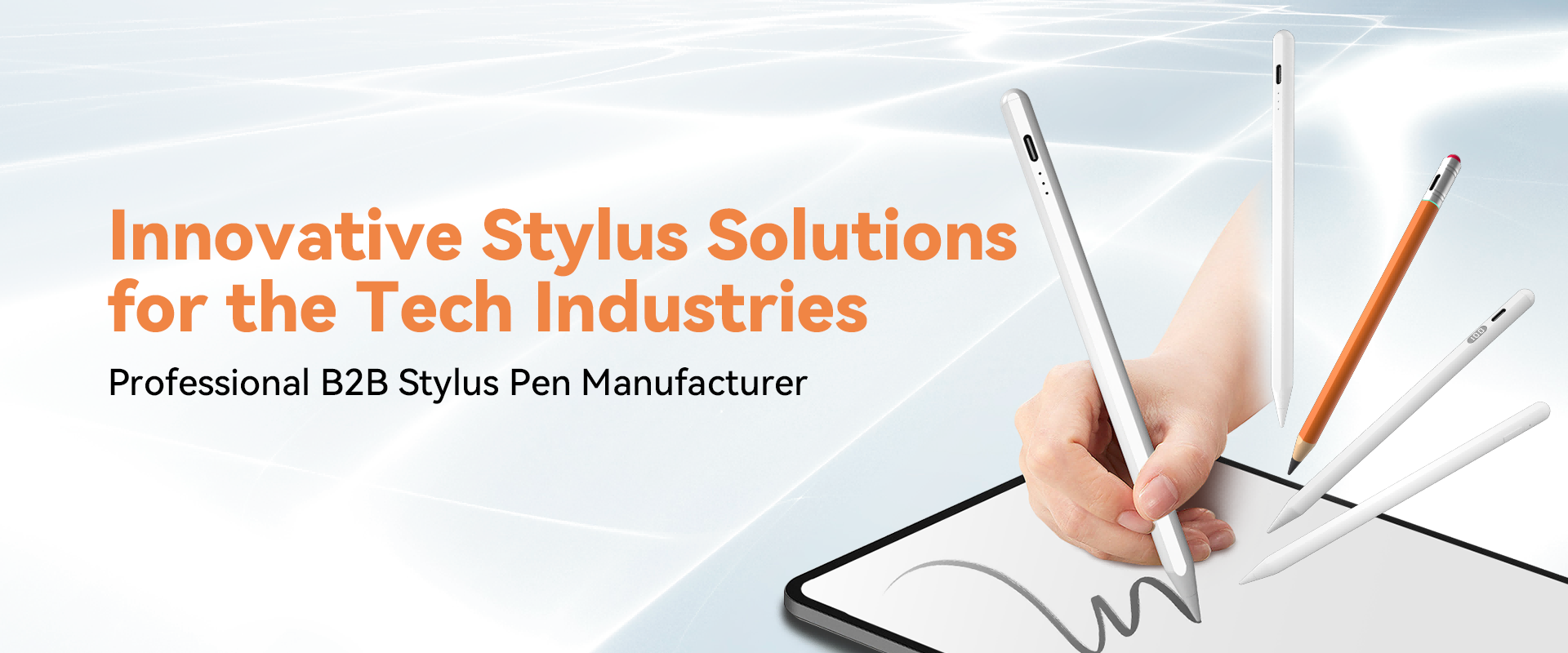

In the booming market of mobile accessories, the tablet stylus has evolved from a simple novelty into an essential productivity tool. For international distributors, wholesalers, and brand owners, choosing the right product line to source is critical.
When evaluating inventory, the choice usually comes down to two main categories: Dedicated iPad Stylus Pens (Active) and Universal Stylus Pens (Passive/Active). While they may look identical on the outside, their internal chipsets, protocols, and targeted user experiences are vastly different.
Here is a comprehensive breakdown of the core differences to help you make informed sourcing decisions.
1. Working Principles & Protocol Differences
The fundamental difference lies in how the pen communicates with the screen.
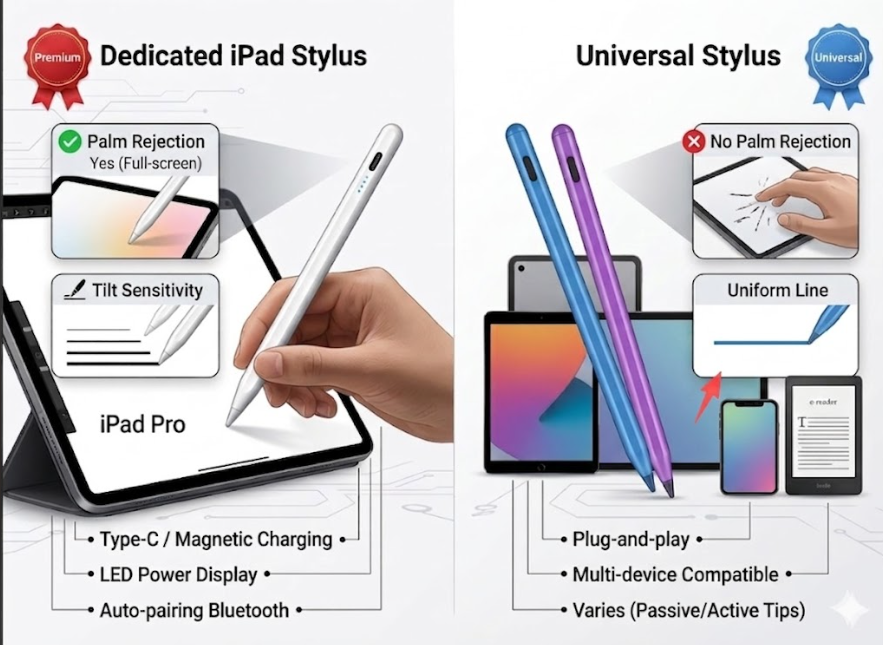
iPad Stylus: These pens are engineered using specific digital protocols that sync directly with the iPad’s display panel. They utilize advanced chipsets to transmit data regarding angle, positioning, and signals that allow the iPad to distinguish between the pen tip and a human hand.
Universal Stylus: These pens operate on a capacitance simulation principle. The pen tip simply mimics the bio-electricity of a human finger. Because it doesn't rely on proprietary protocols, it works on almost any capacitive touchscreen, whether it is an iOS, Android device.
2. Feature Comparison: Functionality vs. Flexibility
| Feature | Dedicated iPad Stylus | Universal Stylus |
| Palm Rejection | Yes (Full-screen). Users can rest their hands naturally on the screen while writing. | No. The screen treats the pen like a finger, so a hand touching the screen will cause stray marks. |
| Tilt Sensitivity | Yes. Changing the angle of the pen alters the thickness or shading of the line. | No. The line width remains uniform regardless of the writing angle. |
| Charging & Battery | Supports Type-C fast charging, wireless magnetic charging, and real-time LED power displays. | Varies. Some require charging for active capacitance; others use passive disc tips requiring no power. |
| Connection Type | Auto-pairing or Bluetooth connection for advanced shortcut functions (e.g., home button click). | Plug-and-play. No Bluetooth pairing or software required. |
3. Hardware Upgrades & Product Trends
As a professional manufacturer, we continuously track hardware iterations to meet market demands:
Charging Interfaces: Dedicated pens have shifted toward advanced SMT charging ports and seamless wireless magnetic charging to replicate the OEM experience.
Design Aesthetics: Modern dedicated lines feature vibrant design trends, such as the popular Macaron color series or nostalgic classic pencil shapes to target student and creative demographics.
Compliance: Newer designs are increasingly focusing on modular components to align with global eco-friendly standards, such as upcoming European battery regulations.
4. Target Audience & Market Positioning
Understanding the end-user profile helps in structuring your sales marketing:
Dedicated iPad Stylus: The Productivity Tool
Target Users: Digital artists, students, remote professionals, architects, and intensive note-takers.
Market Position: Higher profit margins and premium positioning. These buyers prioritize features like lag-free writing, tilt sensitivity for sketching, and palm rejection for long hours of study or work.
Universal Stylus: The High-Compatibility Solution
Target Users: Casual tablet users, kids, navigate-heavy users, and multi-device owners (e.g., using both an iPhone and an Android tablet).
Market Position: Budget-friendly, high-volume turnover. Excellent for promotional gifts, cross-platform retail bundles, and entry-level markets.
Conclusion: Which Should You Source?
For a well-rounded consumer electronics brand, offering a tiered portfolio is ideal.
If your target market demands high performance, precise digital art capabilities, and a premium user experience for iPad ecosystems, Dedicated iPad Stylus Pens are your definitive growth drivers. On the other hand, if you want to capture budget-conscious consumers and Android tablets users with a single SKU, Universal Stylus Pens offer unmatched market reach.
Looking to upgrade your stylus product line? As a dedicated manufacturing factory, we offer full OEM/ODM services for both high-performance active iPad pencils and universal styluses—featuring custom branding, tailored packaging, and certified global compliance. Contact us today to discuss your 2026 product planning.